Learn how our advanced regression analysis transforms complex security data into clear, actionable insights. Our statistical model demonstrates measurable relationships between infrastructure investments and improved safety outcomes.
Understanding Violence Reduction Through Multivariate Regression
Regression analysis helps us understand complex situations in three key ways: describing current conditions, predicting future outcomes, and controlling influential factors.
System Description & Modeling
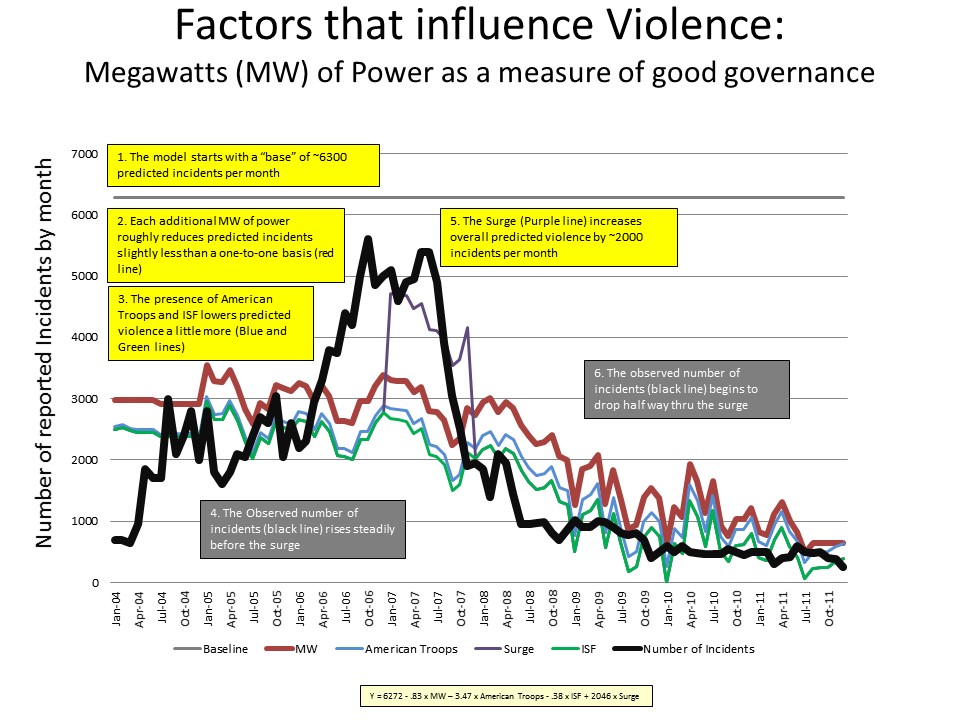
Our regression model examines how various factors affect security incidents in Iraq. The analysis treats predictor variables (electrical power output in megawatts, American troop presence, and Iraqi Security Forces) as fixed values to understand their relationship with monthly security incidents.
Predictive Insights: What The Data Tells Us
Our analysis shows how different factors influence security in Iraq, painting a clear picture of cause and effect:
- Starting Point: Without any interventions, we see a significant baseline level of security incidents each month
- Power Makes a Difference: Communities with better access to electricity experience fewer security problems
- Military Presence: The presence of American forces helps reduce violence
- Local Security Forces: Iraqi Security Forces have a positive impact similar to U.S. troops
- The Surge Effect: During the military surge period, we saw an increase in reported incidents due to intensified operations
Strategic Control
While statistical relationships don’t automatically prove causation, they provide valuable insights when combined with military expertise and on-the-ground observations. Key findings:
- Power Infrastructure Impact: Strong correlation between electrical power availability and reduced violence suggests infrastructure investment promotes stability
- Key Force Balance Insight: Data reveals the optimal ratio between Iraqi Security Forces and American troops for maintaining stability
This analysis draws from established statistical methods as detailed in “Applied Linear Statistical Models” (Neter et al., 1996), while incorporating practical military experience to validate and interpret the findings.
Get Started
Ready to transform your data into actionable insights? Let’s discuss how our proven statistical methods can help you understand and improve stability metrics in complex environments.
Reference: John Neter, et al. Applied Linear Statistical Models. Boston: McGraw-Hill, 1996.
 Mission Metrics Design